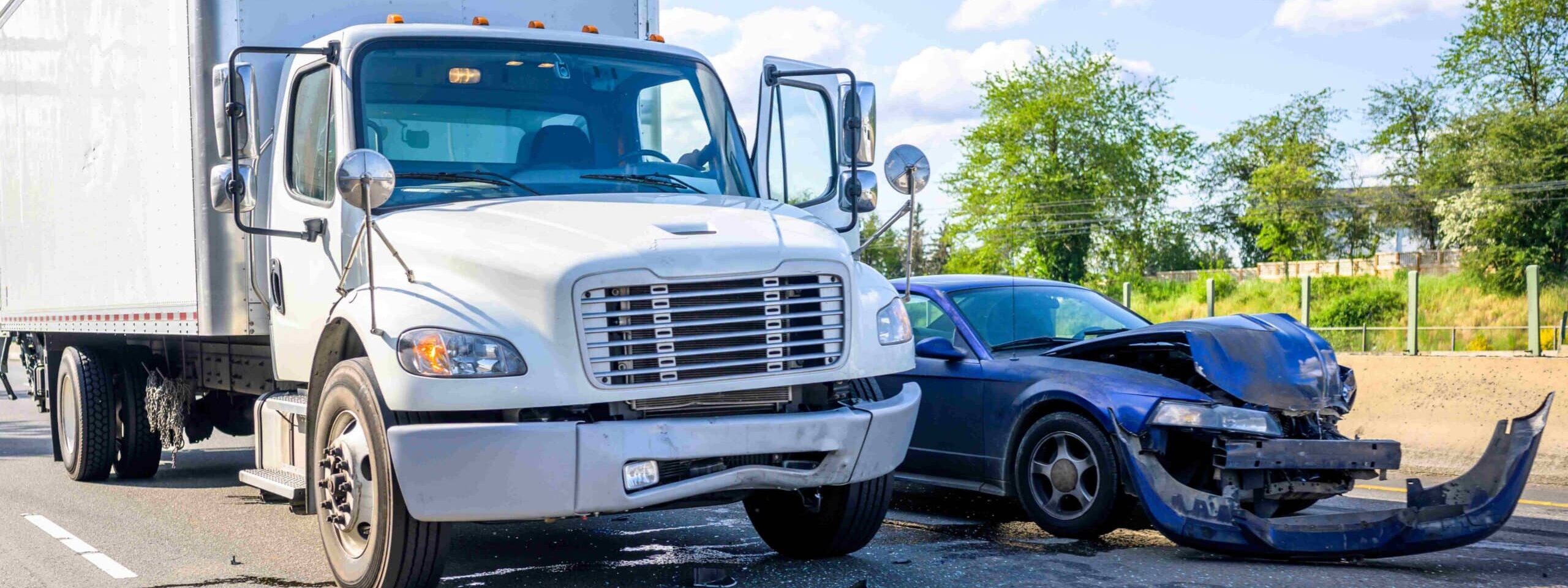
Truck Driver vs. Trucking Company Liability in Indiana Truck Accidents
- Many different parties could be liable for a truck accident, but two of the most common defendants in Indiana truck injury claims are truck drivers and the trucking companies who deploy the trucks and usually employ the drivers.
- Truck drivers generally have direct liability for their own misconduct, while trucking companies tend to have vicarious liability for their drivers’ actions and sometimes direct liability for their own actions as well.
- Regardless of who is at fault for your Indiana truck accident, Hensley has a proven record of demonstrating liability and delivering top outcomes on large vehicle injury cases, like a $25 million verdict* for a collision with an ambulance.
*SPECIFIC CASE RESULTS. NO TWO CASES ARE EXACTLY ALIKE.
Centrally positioned along one of the country’s major freight corridors, Indiana has large trucks and semi-trailers hauling more than 417,000 tons of cargo within its borders each and every day. With so many trucks traveling on local roads and interstate highways like I-65, Indiana truck accidents are all too common, and it’s vital to figure out who is liable for them if you hope to get fairly compensated for the punishing injuries they can leave in their wake.
Because the trucking industry is complex, a wide range of parties might be at fault for an Indiana truck accident, but the two most frequent defendants are:
- The truck driver behind the wheel; and
- The trucking company that sent the driver out.
The distinctions between truck driver liability and trucking company liability can sometimes be confusing, but they can become crystal clear with help from the truck accident lawyers at Hensley Legal Group, PC, a dedicated Indiana personal injury law firm whose experienced attorneys have been fighting on behalf of the wrongfully injured since 1998.
Hensley has been recognized as one of the Best Law Firms in the United States by Best Lawyers® and has achieved many notable outcomes in large vehicle injury cases over the years, including:
- A $25 million verdict for a collision with an ambulance.
- An $8.0 million resolution for a delivery truck accident.
- A $5.5 million settlement for a semi-trailer crash.
Hensley truck accident attorney Sarah Graziano also received the Trial Lawyer of the Year Award from the Indiana Trial Lawyers Association in 2023, while attorneys at the firm have been included in the Academy of Truck Accident Attorneys, the American Association for Justice, Trucking Litigation Group, the Million Dollar Advocates Forum, Super Lawyers, America’s Top 100 Attorneys, and the National Trial Lawyers’ lists of the Top 100 Trial Lawyers and the Top 40 Under 40.
To discover what a seasoned Indiana truck accident attorney can do for you, please call us at (317) 472-3333, chat with us online, or fill out our contact form for a free case review now.
How Liability Is Determined in Auto Accident Cases
Before we delve into how the unique characteristics of commercial trucking can impact truck accident liability, let’s take a step back and look at how liability is determined in auto accident cases no matter what the make or model of a vehicle is.
As with any viable personal injury case, an auto accident case must allege negligence – the failure to exercise sufficient care to avoid harming others – and damages – the negative effects of that negligence. An individual or entity whose negligence brings about an auto accident that results in damages is said to have liability for the auto accident, and the nature of that liability will be a function of that individual’s or entity’s actions.
In approximately 94 percent of auto accidents, a driver’s action will have served as “the last event in the crash causal chain.” Essentially, these accidents mostly happen because drivers make mistakes, so the lion’s share of the liability for an accident should lie with the driver whose mistake caused the accident (although another party might contribute to or even be the sole cause of an accident in some scenarios).
This is known as direct liability, since it arises directly out of the driver’s own negligent actions. As such, the driver may be legally liable for any tickets written or charges filed by the authorities over those actions, not to mention financially liable for any civil claim or lawsuit that may be pursued by a plaintiff injured in that accident, to which the driver would be a defendant.
If the driver owns the vehicle being driven, there might not be any other defendants. However, if the vehicle is owned by somebody else, the owner of that vehicle might have liability too, but it wouldn’t be direct liability since the accident didn’t arise directly out of the owner’s actions.
Instead, it would be classified as vicarious liability, in which “a principal party is responsible for the actionable conduct of their agent based on the relationship between the two parties.” By giving the driver permission to drive the owner’s vehicle, the owner becomes vicariously liable for any damages that the driver inflicts with that vehicle.
That doesn’t mean that the owner will face misdemeanor or criminal penalties like the truck driver might, but it does mean that the owner might bear fiscal responsibility for the collision, though the main source of reimbursement for it will typically be the owner’s insurance policy on that vehicle.
While the stakes involved in a fender bender between two cars are obviously much smaller than they would be in a crash with an 18-wheeler, the core principles of liability remain the same, both for the truck’s driver and its owner (usually the trucking company employing the driver).
Truck Driver Liability
As we’ve already explained, if the blame for an auto accident can be assigned to a truck or semi-trailer, the driver of the truck is likely to be liable on the basis of direct liability, i.e. for negligent acts by the truck driver. Examples of truck driver misconduct that could lead to an Indiana truck accident include:
- Speeding
- Distraction
- Calling or texting while driving
- Drug or alcohol intoxication
- Following too closely (tailgating)
- Not yielding the right of way
- Improper passing or overtaking
- Abrupt lane changes
- Ignoring traffic control signals
Obviously, these errors aren’t only made by truck drivers, and truckers might actually be less prone to make them than other drivers thanks to the advanced training that they have to undergo in order to obtain commercial licenses. On the other hand, there is one kind of wrongdoing to which truck drivers may be more susceptible, and that’s driving while drowsy.
Because truckers drive for most of their waking hours compared to the 63 minutes per day that the average motorist drives, their odds of succumbing to fatigue could be considerably greater. To combat this problem, the Federal Motor Carrier Safety Administration (FMCSA) has imposed strict Hours of Services (HOS) regulations that cap how long truckers can drive. Furthermore, truck drivers are required to take breaks during their shifts and a minimum amount of time off between each workday and each work week.
Breaching these regulations might constitute a violation of federal law, and it would definitely constitute direct liability for any Indiana truck accident that takes place because of it, as could any other negligent driver actions that played a role in the accident.
Trucking Company Liability
In contrast to truck drivers, who tend to have direct liability for truck accidents almost exclusively, trucking companies tend to have vicarious liability for their drivers’ actions, though the companies may have some level of direct liability for their own actions in some circumstances.
Vicarious Liability – As the owner of the truck or semi-trailer entrusted to the employee truck driver, the trucking company will be vicariously liable for the actions of the driver that contribute to a truck accident for the reasons described above. And if the trucking company happens to be the truck driver’s employer, as is often though not always the case, that vicarious liability would probably take a particular form: respondeat superior.
Latin for “let the master answer,” respondeat superior is a legal doctrine under which an employer or principal will be legally liable for the wrongful actions of an employee or agent, provided that those actions are with the scope of his or her employment or agency.
It should be noted that these conditions might create an opening for the trucking company to argue that the truck driver was actually an independent contractor and not a classic employee, meaning that his or her actions would not be an employee’s actions for which an employer has to “answer.” Nevertheless, this defense might be challenged on the grounds that the trucking company had such control over the trucker (e.g. control over the vehicle, the hours, or the route) that the company and the driver had an employment relationship in all but name only.
Direct Liability – Although trucking companies primarily have vicarious liability for their drivers’ negligence, there are situations in which a trucking company may have direct liability for an Indiana truck accident because of its own negligent actions. Examples of direct negligence by a trucking company may include:
- Negligent hiring (taking drivers on with lax qualifications or poor driving histories)
- Negligent training or supervision (not educating drivers adequately or not verifying that they’re obeying the rules)
- Negligent retention (not firing drivers who behave badly)
- Negligent maintenance (not keeping the trucks in safe working order)
- Encouraging negligent behavior (pushing drivers to violate HOS regulations or other laws)
These sorts of negligent actions would make a trucking company directly liable for a truck accident, although the company may still be vicariously liable for any negligence on the part of the driver, and others might be liable in addition to them.
How Our Truck Accident Attorneys Can Demonstrate Liability
As you can see, various defendants could have various degrees of liability for the same truck accident, and it’s important to identify every single one of them that you can identify every means of recovery, especially since some defendants may have more means than others.
Whereas a truck driver may have relatively shallow pockets that could be empty before you know it, a trucking company might have upwards of $1 million (or more) in commercial insurance coverage for a given Indiana truck accident, depending upon what’s inside the truck. Those are some very deep pockets indeed, but you will have to demonstrate the policyholder’s liability to reach into them, along with the liability of everyone who hurt you, and this is where the skilled Indiana truck accident attorneys at Hensley Legal Group can make a huge difference.
If you hire Hensley, our firm will launch a comprehensive investigation to unearth the root causes of your truck accident and the defendants who may be liable for it, a group that will almost certainly include the truck driver and the trucking company. We will then establish valid claims against them within the time allotted by law and possibly file a lawsuit as well in a court with the power to issue a binding judgment.
Next, our tenacious truck accident lawyers will move swiftly to amass the materials necessary to demonstrate liability on the part of the defendants, whether it’s direct or vicarious, such as:
- Police reports
- Citations and dispositions
- Eyewitness statements
- Crash site photos
- Dash cam (inward and outward), streetlight, yard, warehouse, and surveillance videos
- Black box data
- Electronic Control Module (ECM) data
- Electronic Logging Device (ELD) data
- Call logs
- Hiring and training documentation
- Driver Qualification Files (DQFs)
- Motor Vehicle Records (MVRs)
- Drug and alcohol tests
- Dispatch messages
- Bills of lading
- HOS, inspection, and maintenance histories
- Accident reconstruction and forensic analysis
To ensure that these items are preserved for detailed examination in coordination with experts of our choosing, any correspondence with the trucking company will include language warning of stiff legal repercussions for “spoliation of evidence,” defined in Glotzbach CPA v. Froman as:
“the intentional destruction, mutilation, alteration, or concealment of evidence.”
This is no idle threat either. It’s a solemn promise to hold the defendants accountable for any attempts to conceal their liability or the liability of anybody working for them – as solemn as the promise our truck accident attorneys are making to you to do whatever it takes to get you the compensation you deserve.
Get in Touch with Our Indiana Truck Accident Lawyers
Hensley Legal Group has been fiercely advocating for the innocent victims of negligence for more than 25 years. If you’ve been seriously injured by the carelessness of a truck driver or trucking company in the Hoosier State, get in touch with our Indiana truck accident lawyers to learn more about your legal options.
You can schedule a no-cost consultation with a knowledgeable Indiana truck accident attorney by calling us at (317) 472-3333, chatting with us online, or filling out our contact form today.
Frequently Asked Questions
Who can be liable for a truck accident?
Many parties could be liable for a truck accident, but two of the most common defendants in Indiana truck accident claims are the drivers of the trucks and the trucking companies.
However, the different types of defendants usually have different types of liability, with a truck driver mainly having direct liability for a truck accident and a trucking company mainly having vicarious liability.
What is direct liability?
Direct liability is liability that arises directly out of a defendant’s own negligent actions.
This is the kind of liability that truck drivers tend to have, with the mistakes they make directly leading to the truck accidents at issue.
What is vicarious liability?
Vicarious liability is liability in which “a principal party is responsible for the actionable conduct of their agent based on the relationship between the two parties.”
This is the kind of liability that trucking companies primarily have, since they are more often held liable for the actions of the drivers to whom they entrust their trucks than for their own direct actions. And because trucking companies generally employ these drivers, their vicarious liability might be more accurately classified as respondeat superior, a doctrine under which an employer or principal is legally liable for the wrongdoing of an employee or agent.
Can a trucking company have direct liability?
There are situations in which a trucking company can have direct liability for a truck accident because of its own misbehavior. This may include negligence in employee hiring, training, supervision, and retention, along with inadequate truck maintenance and encouragement of negligent behavior in others.
It should be noted that a trucking company’s direct liability doesn’t prevent it from still having vicarious liability for misconduct by a truck driver or someone else under its control.
What evidence is needed to demonstrate liability?
The sort of evidence needed to demonstrate liability will depend upon the circumstances surrounding an Indiana truck accident, though it may include:
- Police reports
- Citations and dispositions
- Witness statements
- Photos and videos
- Cellphone usage
- Black box, ECM, and ELD data
- Hiring and training documentation
- DQFs and MVRs
- Drug and alcohol tests
- Dispatch messages
- Bills of lading
- HOS logs
- Inspection and servicing histories
- Accident reconstruction and forensic analysis
But no matter what proof of liability is ultimately required, you can count on the Indiana truck accident lawyers at Hensley Legal Group, PC to work tirelessly to unearth it.
Available 24/7
Free Case Review
You won’t pay any fees until we win your case.
It’s easy - you can: