Multi-Car Pile-Up in Indiana: How Fault Gets Split When Three or More Drivers Are Involved
Indiana’s “comparative fault” laws mean that you can receive compensation for an accident even if you are partially at fault, so establishing a liability chain is important. These chains can be very confusing in multi-car pile-ups, where there are competing claims of fault and many people can be at least partially liable. Hiring an Indiana […]
May 5, 2026
- Indiana’s “comparative fault” laws mean that you can receive compensation for an accident even if you are partially at fault, so establishing a liability chain is important.
- These chains can be very confusing in multi-car pile-ups, where there are competing claims of fault and many people can be at least partially liable.
- Hiring an Indiana car accident attorney who understands how to determine liability is the best way to get the compensation you deserve.
Imagine you are out for a drive. You’re traveling east near the intersection of 71st and Marsh in Indianapolis, near Eagle Creek Park. It’s pretty, but there are also a lot of highway exchanges and sometimes people get lost. The car in front stops suddenly; the driver is clearly not sure where to go. You don’t have time to stop and crash into it.
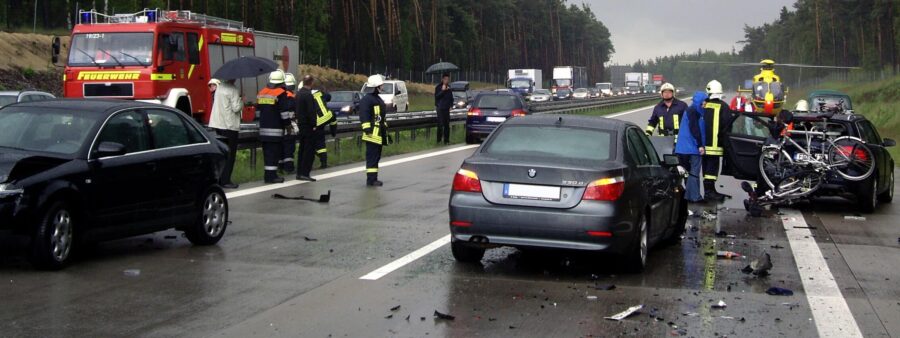
To make things worse, the car behind you also can’t stop. Suddenly, you are in a multi-car pile-up accident. This is a dangerous scenario, and one that creates the potential for confusion when filing your claim.
These multi-car pile-ups can happen anywhere in Indiana, on local, county, or state roads. When there are three or more cars involved in an accident, determining fault can be a challenge, due to the nature of the crash and Indiana’s laws. Hiring Indiana car accident attorneys who can cut through the confusion is the best way to have a successful claim and get back on the road.
Understanding Indiana’s Comparative Fault Laws
Indiana is known as a “comparative fault state” when it comes to awarding damages after an accident. As IC 34-51-2 explains, “In an action based on fault, any contributory fault chargeable to the claimant diminishes proportionately the amount awarded as compensatory damages for an injury attributable to the claimant’s contributory fault, but does not bar recovery.”
OK, that doesn’t explain a lot, unless you went to law school. But what it means is that if you are in an accident you are allowed to recover damages, with two caveats:
- You must not be MORE at fault than the other party.
- The damages may be reduced by your degree of fault.
To simplify this, let’s say you are in a car accident with someone who blew through a light that just turned red. The car hit the front of yours as it drove past. In this case, let’s imagine that you and the other driver want to blame each other and be compensated.
It is found (whether through insurance companies adjudicating internally or at a trial) that the other driver is at fault. Under Indiana law, a driver who is 51% or more at fault cannot collect any damages, which means you win. You are less at fault, and the jury awards $100,000.
However, it is also found that you were a little bit in the intersection. The other driver was clearly at fault, but had you not been in the intersection your car would have been missed altogether. The jury has instructions to decide what percentage of the fault is yours. If they say it is 20% your fault, you still get damages minus 20%. So in this case you would be awarded $80,000.
This seems complex, and it only gets more so with multi-car pile-ups.
How To Split Fault When Three or More Drivers Are Involved in Indiana
Let’s go back to our initial example. To the front car, you probably have the most fault since you didn’t stop and crashed into it. To you, the car behind you might have more fault because it hit you and pushed you into the car ahead.
The words “probably” and “might” aren’t ones that insurance companies like to use. They want to assign blame, and the insurers for the other drivers will try to pass it along. That’s the job of insurance, which is why you should NEVER talk to an opposing insurance company before getting legal representation.
What you should do is collect evidence. Establishing a chain of responsibility is very challenging when there are multiple cars. The facts that can help you create your case include:
- Witness statements (both people involved and not involved)
- Photos from the scene
- Videos from traffic cameras
- Footage from home/business cameras in the area
Photos are extremely important, because they can be used to assess front and rear damage and determine if someone was pushed or crashed into a car. You might say you were pushed into the car in front of you, and the other driver might say you crashed into the car. Photos of the damage can be used to determine who is right.
(Remember that it isn’t always a matter of “lying.” Accidents are scary and jarring and people can be confused, which is why evidence matters.)
All of this will be used during negotiations or at trial to establish who was most at fault. If you are found less than 51% at fault, you can collect damages…minus the percentage you are to blame.
This process can be complex, of course. That’s why you need a qualified and experienced multi-vehicle accident attorney who understands Indiana law and can manage the difficulties of your case.
Dealing with your own insurance is hard. Dealing with someone else’s insurance who is trying to pin the blame on you is scary and frustrating. Dealing with multiple insurance companies is nearly impossible on your own.
Your Indiana car accident lawyer can deal with everyone, and work to get you the resolution you deserve.
Reach Out to Our Experienced Indiana Multi-Car Pile-Up Accident Attorneys
Multi-car accidents in Indiana can create multiple challenges. You need someone who will fight through all of them, like the car accident lawyers at Hensley Legal Group, PC, a dedicated Indiana personal injury law firm whose experienced attorneys have been fighting on behalf of the wrongfully injured since 1998.
Simply call us at (317) 472-3333, chat with us online, or fill out our contact form now for a free consultation with a knowledgeable Indiana car accident attorney.
Available 24/7
Free Case Review
You won’t pay any fees until we win your case.
It’s easy - you can: